
Showing posts with label Races. Show all posts
Showing posts with label Races. Show all posts
Monday, July 8, 2013

Friday, May 17, 2013
Devils

Devils and demons often play an antagonistic role in fantasy. They take on many different forms and come about in so many different ways. Some are malevolent spirits, others are creatures summoned from another realm, others come from the ground and have nightmarish bodies. All seem to be evil or at least neutral, and are often dangerous when summoned, kept barely under control, if controlled at all.
The concept is mostly associated with Christianity, where the devil, Satan or Lucifer, is a fallen angel opposing God's plan, and trying to lead men to hell. Some say he is the master there, others that he just wants people to be miserable with him. Some say he works alone, others with his demon minions. Most other religions have a devil or some other sort of adversary as well, although now people seem to want to focus on goodness and leave the devil out of it, ignoring him or not believing in one.
The image of the devil came in the middle ages, when priests thought that their followers were not scared enough by the devil, so they made an image meant to frighten people into righteousness. The devil had horns on his head, hooves like a goat, claws, and a tail. Kind of like a satyr, but red. Sometimes they gave him batwings. He used a pitchfork as his weapon. Other demons had similar characteristics. Usually ugly, they might also be beautiful, to seduce you.
Usually in books, these devils or demons don't look like the classical description. The most common is the spirit, since that is what devils are, if they exist (you don't see demons walking around, at least not how they are shown in pictures. People you know, however, like your in-laws if you're unlucky, might be personal demons for you). Sometimes they will possess bodies, a common idea in fantasy.
In games, sometimes they will be shown in a physical form. In Heroes of Might and Magic 6, the demon faction has 7 creatures, each representing one of the deadly sins. In literature, they represent the dark side of humanity, the nightmares, the fears, the depraved acts humans can commit. In this way, Pandora of mythology was the mother of all demons. They also often represent fire, or are represented by it, which, with Prometheus, acted the same way as the forbidden fruit of Adam and Eve: it brought knowledge to humans and the ability to act for themselves, separating them from animals. This knowledge burned with the pains of sin and the light of knowledge.
Since they are rarely, if ever, the good guys, they are a bit more one dimensional than other fantasy creatures. Because of this, and because people are more uncomfortable with religion, they are less and less common as characters. If thinking about using demons, be aware of what they represent and if they go long with the story, and use them in a creative way.
Reblogged from http://sageeyesblog.wordpress.com/2013/01/30/devils/
Thursday, May 16, 2013
Orcs

Ever since Lord of the Rings, the orcs have been picked on (considering they pretty much first appeared in those books, they've been picked on forever). Normally, they are a race of misshapen, or at least ugly, large humaniods that are stronger than they are smart. Often, they are evil, and make up the armies of the enemy, an almost limitless host that dares the good guys to defy the odds.
When talking of orcs, often they're more of a conglomeration of creatures of legend. Goblins, trolls, ogres, and others can often fit into the category 'orc'. Usually, they are big, ugly, and mean. Oftentimes they are green or brown, but they can pretty much be any color or size. The term is so general it can mean anything, really.
Lately, they've been given a little slack. Tolkien first created them as parallels to the Nazis. We don't live in a world of Nazi Germany anymore, though, so there are no clear enemies like there were then. There's no country we can point to and say, "They're evil." Some of the communist countries might have challenged, but since the collapse of the USSR, they're not so much a threat. Islamic extremists have caused us problems, but most are quick to point out that they don't represent the overall Muslim population. So, like I was saying, without any clear enemy, our need to symbolize a race of evil in fantasy has diminished. Some dark lords still use orcs or other similar races for recruitment, while others just use good old humans. The orcs are becoming more like the Na'vi in Avatar: noble savages.
In Warcraft 3 and World of Warcraft, for example, (Real time strategy and massive online role playing video games, respectively), the objective of defeating the evil orcs changed to defeating evil demons and undead. It does make them more dimensional than the evil creatures they were before, because let's face it. No culture or nation is completely evil. Even Nazi Germany had good people, they were just unable or unwilling to act out against the evil leaders put in place by Hitler, as well as not realizing at the time how he was slowly changing the nation into a monster (a dire warning for us: if any president starts radically changing the country, it probably isn't for the better).
Just like the real world, most think orc points of view should be represented in fantasy, instead of blindly pointing to them as evil monsters. It gives the world more complexity and points to more modern views: no culture is pure evil or pure good. There can be more depth to the orc race, and there are many possibilities for them to play roles they couldn't before. It is interesting that the orcs can be explored beyond their evil origins, and there is material to be used, but it gives us the question: if they are no longer just the bad guys, but are as dynamic in morality as humans, is there really any need to have them? Why not just have humans take their place?
So the future of the orc maybe isn't as bright as they thought after their change of heart. They will at least be around for two more Hobbit movies in their evil form. after that, who knows? The noble savage idea is already getting a little old itself. Were indians and africans really all that closer to mother earth? Would they have abstained from ripping her apart if they had the means? Who knows? But maybe the new role of the orc will be mother nature's champions. It wouldn't be a huge leap.
After all, they've already gone green.
Reblogged from http://sageeyesblog.wordpress.com/2013/01/23/orcs/
Races, Species, Creatures, Cultures
Like I have mentioned in other posts, one of the ideas I want to
explore in my stories is how humans would react to other sentient
species or races. I want to use familiar concepts for fantasy, so right
now I don't have anything really new, but I don't know if they've all
been together before. The working structure I have set up for the races
are as follows.
Humans (Humans, dwarfs, centaurs, etcs) Norsh and Greek influence
Faery (Elves, fairies, nymphs, etc) Irish and Greek influence
Orcs (Orcs, goblins, ogres) European influence
Demons (Demons, devils, imps, etc) Christian influence
Undead (Skeletons, vampires, zombies, etc) European influence
Feral Creatures (Minotaurs, djinn, hydras, etc) Middle Eastern, Greek, and other influences
Looking over this, a lot does seem to come from Europe and especially Greek myth, partly because, as far as creating interesting creatures goes, they are some the richest, but other creatures from myths all over the world are welcome, and I am researching them. I just want to avoid creatures that are just big animals, like giant spiders, and too many half human half animal combinations, like centaurs, satyrs, dryads, etc. If there is something obvious that I am missing, please let me know in the comments.
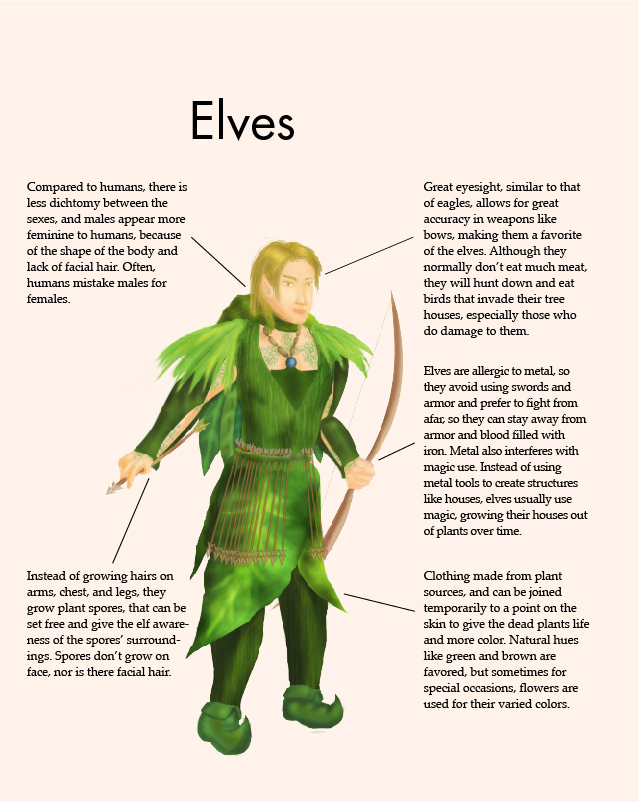
As far as cultures go, I want to be much more diverse, taking from cultures all over the world and through history. For example, I would like to make some of the elven cultures mirroring principles of honor held in Japan, especially the before their integration into the modern world.
So many people think that their culture is the best and only one worth having, even though it is always changing through time and geography. Many conflicts in history have been with cultural clashes, everyone thinking their way of life was better. But if one journeys through different cultures, opening oneself up, they realize their way of life is but one in a buffett of many others. There are good and bad things in each culture, as well as good and bad people. We just have to get along, respecting differences.
Reblogged from http://sageeyesblog.wordpress.com/2013/01/06/races-species-creatures-cultures/
Humans (Humans, dwarfs, centaurs, etcs) Norsh and Greek influence
Faery (Elves, fairies, nymphs, etc) Irish and Greek influence
Orcs (Orcs, goblins, ogres) European influence
Demons (Demons, devils, imps, etc) Christian influence
Undead (Skeletons, vampires, zombies, etc) European influence
Feral Creatures (Minotaurs, djinn, hydras, etc) Middle Eastern, Greek, and other influences
Looking over this, a lot does seem to come from Europe and especially Greek myth, partly because, as far as creating interesting creatures goes, they are some the richest, but other creatures from myths all over the world are welcome, and I am researching them. I just want to avoid creatures that are just big animals, like giant spiders, and too many half human half animal combinations, like centaurs, satyrs, dryads, etc. If there is something obvious that I am missing, please let me know in the comments.
As far as cultures go, I want to be much more diverse, taking from cultures all over the world and through history. For example, I would like to make some of the elven cultures mirroring principles of honor held in Japan, especially the before their integration into the modern world.
So many people think that their culture is the best and only one worth having, even though it is always changing through time and geography. Many conflicts in history have been with cultural clashes, everyone thinking their way of life was better. But if one journeys through different cultures, opening oneself up, they realize their way of life is but one in a buffett of many others. There are good and bad things in each culture, as well as good and bad people. We just have to get along, respecting differences.
Reblogged from http://sageeyesblog.wordpress.com/2013/01/06/races-species-creatures-cultures/
Wednesday, May 15, 2013
Fantasy Races
One of the themes in my books is racism, and so I wanted to have
different races to explore that. How would humans act if confronted with
another race or species that was as smart as they were. Science fiction
sometimes deals with that, finding alien races, but fantasy does as
well. There are the normal ones, like dwarves, elves, orcs, etc. Some
authors, like Tolkien, have used these familiar races (or in his case,
practically invented them), while others create their own races, often
similar but with different names (trollocs as orcs from The Wheel of
Time). Others just stay with humans and maybe some creatures (Song of
Fire and Ice). I am writing thinking of using the familiar races and
creatures, because they are familiar. I will add my own take on them,
but right now, the names are the same. I felt that just changing the
names wouldn't do much since people will think of them that way anyway.
Anyone have any ideas on this? Comments? Should I have made some
completely different races that don't look like humans at all? Would
people be able to identify with them if I didn't? I feel like taking the
Harry Potter approach, and using the familiar, although in a different
way. But maybe someone can convince me to be completely original with
this. Who knows?
Reblogged from http://sageeyesblog.wordpress.com/2012/12/30/fantasy-races/
Reblogged from http://sageeyesblog.wordpress.com/2012/12/30/fantasy-races/
Subscribe to:
Posts (Atom)